
Why an Unfinished Puzzle Calls You Back
The famous Zeigarnik effect has been oversold. The stronger finding is simpler: when an interrupted task is waiting, people often choose to resume it.
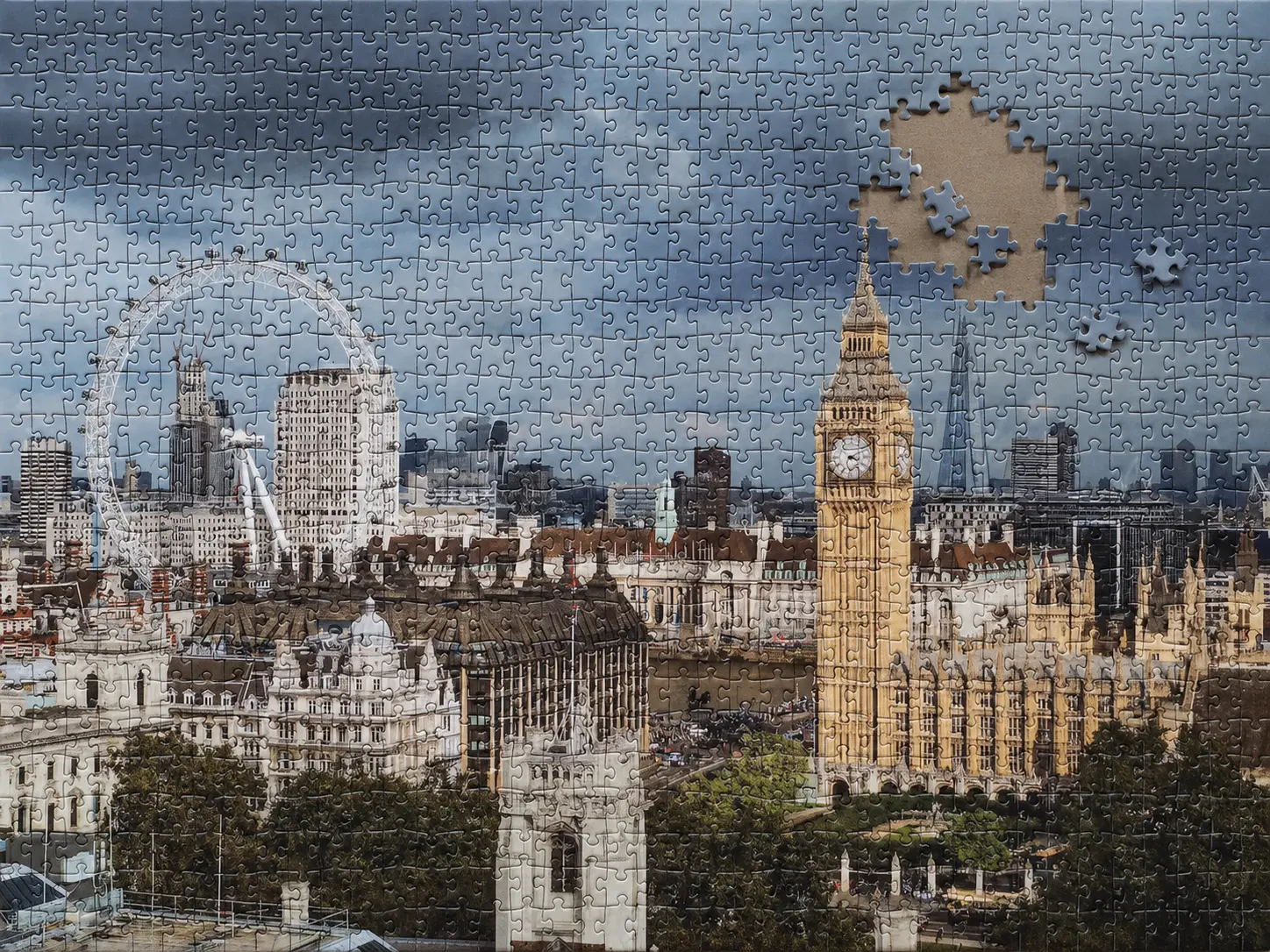
Most of London is finished. Big Ben is in place, the London Eye has all its spokes and the Palace of Westminster stretches neatly across the table. Then your eye reaches the sky: one bare patch of board, with several blue-grey pieces lying nearby.
You can leave it alone. Of course you can.
But the next time you pass the table, one of those loose pieces will get a quick turn. Perhaps two. This is often explained with the Zeigarnik effect, usually condensed into a catchy claim that the brain remembers unfinished tasks better than finished ones. The claim has travelled much farther than the evidence.
The more reliable finding is not about remembering. It is about going back.
A waiter, some clay and a very interrupting researcher
Bluma Zeigarnik worked at the Psychological Institute of the University of Berlin in the 1920s. The story usually begins in a café, where her colleague Kurt Lewin noticed that a waiter seemed to remember unpaid orders and forget the details once the bill was settled. Zeigarnik took the idea into the laboratory.
Her participants were given between 18 and 22 short tasks. They solved arithmetic problems and puzzles, made cardboard boxes, drew, and modelled figures from clay. About half the tasks were interrupted before completion. Afterwards, the materials were cleared away and participants were asked to recall what they had done.
Zeigarnik reported a substantial advantage for interrupted tasks. The timing of the interruptions was not random in the everyday sense: the experimenter tried to stop people when they were engrossed, often just after they had worked out how to proceed. Her paper gives a splendidly specific example. A clay animal had become dog-like, but was still in danger of ending up a cat. Then the researcher moved the participant to something else.
People objected. Some were decidedly reluctant to stop. That reaction is as interesting as the memory scores, because it points towards a second question: when the unfinished task remains available, will someone choose to continue?
Maria Ovsiankina, another researcher in Lewin’s circle, studied exactly that. Participants often resumed interrupted work without being instructed to do so. Her name is now attached to the Ovsiankina effect, although it receives far less popular attention. Apparently “people tend to pick the thing up again” is not as useful for productivity headlines as a mysterious memory hack.
The famous effect and the sturdier one
Later experiments struggled to reproduce a general memory advantage for unfinished tasks. A 2025 meta-analysis by Romain Ghibellini and Beat Meier brought together the research on both effects. It found no overall recall benefit for interrupted work.
The return tendency held up better. Across the studies included in that part of the analysis, interrupted tasks were resumed roughly 67 per cent of the time when an opportunity arose. The authors treat that figure as indicative rather than a law for every situation—the studies used different tasks and procedures—but the direction is clear. People resumed more often than they did not.
This distinction clears up a lot of muddled advice. An unfinished crossword may not occupy a privileged vault in memory. You can forget the clue, the guesses and the mildly brilliant theory you had before dinner. Yet when the grid appears again, the empty squares make continuing easy.
The puzzle remembers for you.
Progress left in plain sight
A jigsaw stores its history on the table. Joined pieces show which regions are settled. Empty board shows what remains. Loose pieces can be sorted by colour, edge or a suspicious bit of clock tower. You do not have to reconstruct yesterday’s thinking before making a move.
Crosswords do the same with ink. A seven-letter answer that began as a blank now has three crossing letters, so dozens of possibilities have quietly disappeared. Sudoku candidates, pencilled notes and filled regions all preserve the state of the problem outside your head. Even a 1969 computer Hangman game could keep a player moving by printing each newly revealed letter.
This makes puzzles unusually resumable. Compare “finish the jigsaw’s sky” with “sort out the finances”. One has a visible gap and a finite set of pieces. The other is a fog bank wearing a sensible tie.
Clear boundaries also make stopping safer. You can leave a crossword after 12 clues because the page will still show what you solved. Nothing needs to stay mentally active overnight. The unfinished state is not a threat; it is an invitation waiting exactly where you put it.
Games can exploit that invitation. Endless collections, expiring events and progress bars create unfinished business on purpose, then attach a cost to ignoring it. The psychology of returning is not automatically pleasant. Choice matters. So does the presence of a real ending. A good puzzle should let you leave without turning absence into a penalty.
Leave yourself an easy return
There is a practical lesson here, but it is smaller than the usual claims about “hacking” the Zeigarnik effect. If you want to resume something, make the next move visible.
Research by E. J. Masicampo and Roy Baumeister found that unfulfilled goals could interfere with unrelated work, while making a specific plan for completing them reduced that interference. The goal had not been achieved. It had simply stopped demanding that the person repeatedly work out what to do next.
Puzzle solvers leave these plans everywhere. A promising jigsaw piece sits beside the gap where it might belong. A difficult crossword clue gets a circle. A tentative letter remains in pencil. None of this guarantees better memory, and none of it needs to. It lowers the cost of returning.
Before walking away from a puzzle, put one plausible piece beside the empty space. Tomorrow you will not need a psychological effect with a famous name. You will know where to start.
Sources and further reading
- “On Finished and Unfinished Tasks”, Bluma Zeigarnik’s original study in English translation.
- “Interruption, recall and resumption: a meta-analysis of the Zeigarnik and Ovsiankina effects”, Romain Ghibellini and Beat Meier, Humanities and Social Sciences Communications (2025).
- “Consider it done! Plan making can eliminate the cognitive effects of unfulfilled goals”, E. J. Masicampo and Roy F. Baumeister, Journal of Personality and Social Psychology (2011).
- Original Palace of Westminster thousand-piece jigsaw photograph, Colin, licensed under CC BY-SA 4.0. Digitally edited for Puzzle Meadow to show an unfinished puzzle.
