
The Computer That Asked for a Letter
A 1969 catalogue preserves one of the earliest documented computer word games: Dan Miller’s Hangman, built for a machine with almost no room to spare.
On page 96 of a thick computer-program catalogue from November 1969, between a cocktail generator called Fran the Barmaid and a collection of patches for the FOCAL programming language, there is a wonderfully plain entry:
The program allows the user to play the game of Hangman with the computer.
That is the entire sales pitch. The game was written by Dan Miller of Glastonbury, Connecticut, and listed as DECUS FOCAL-42 under the title The Hangman Game. No screenshots. No feature list. If you wanted it, the catalogue told you which program to request and the user society supplied the material on paper tape or another storage medium of the period.
It is one of the earliest computer word games we can document with a date, an author and a surviving catalogue entry. More importantly, it shows how little machinery a computer needs before it can become a puzzle partner.
A game with no screen
Hangman asks for very little. The program stores a secret word, accepts a letter, checks whether the letter appears and prints the new pattern. It also keeps count when the player is wrong. The computer does not understand the word, recognise a clever guess or enjoy the suspense. It just knows something you do not.
In 1969, that was enough to feel different.
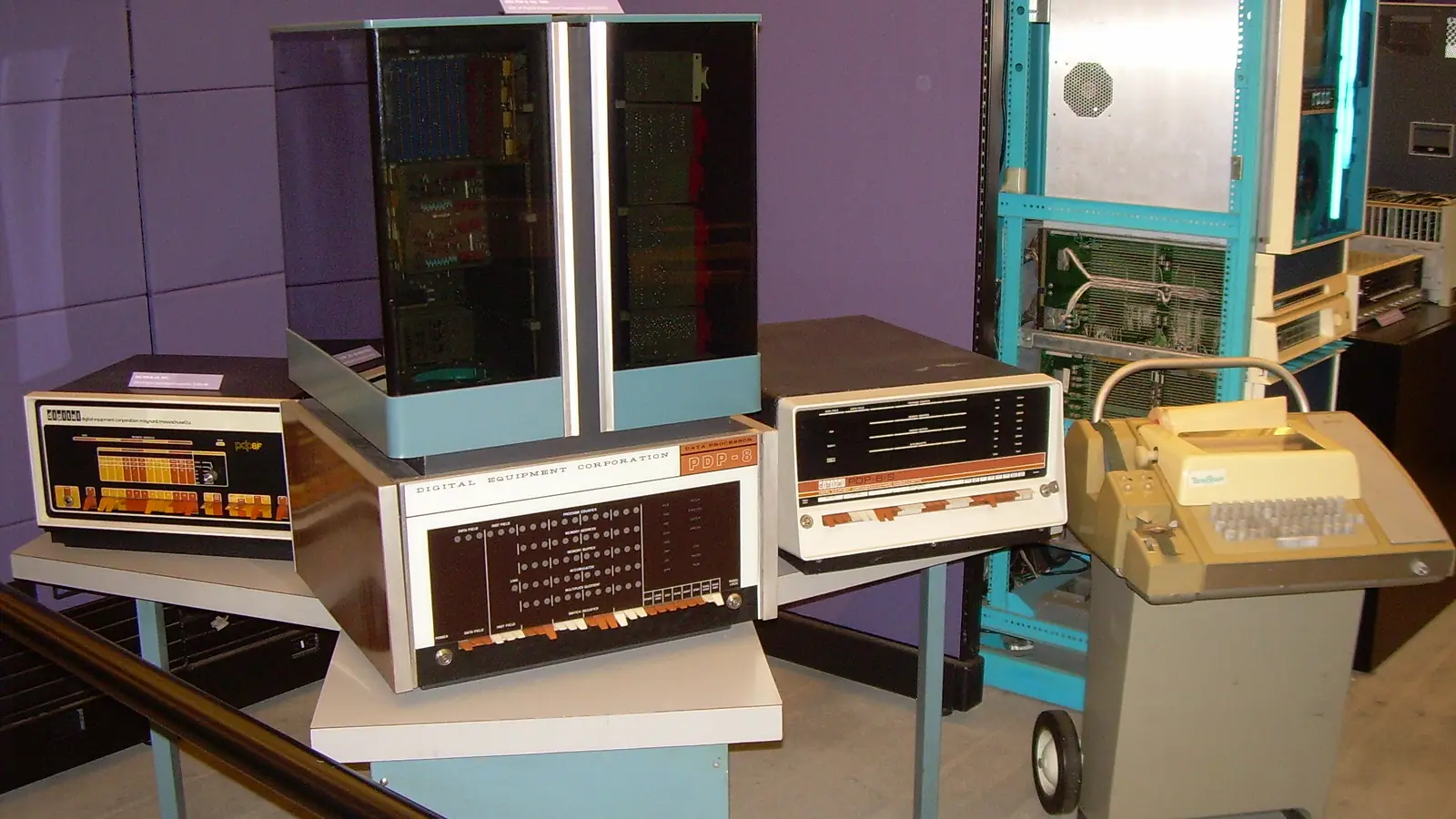
The game did not require anything we would now call a graphical display. On a common setup of the period, a Teletype could send the player’s input to the computer and hammer the reply onto a roll of paper. Each guess pushed the conversation down the page: blanks, letters, mistakes, another prompt. At the end, the paper held the whole game, including every confidently wrong turn.
Miller wrote the program in FOCAL ’68, short for Formula Calculator. Digital Equipment Corporation had designed FOCAL as an approachable, interactive language for its smaller computers. It handled calculations and teaching exercises, but users quickly found less official things to do with it.
The DECUS catalogue confirms the mood. Its “Game, Demonstration” listings include dice, tic-tac-toe, music, The Sumer Game, Hexapawn and the aforementioned electronic barmaid. These programs sat in the same library as statistical routines, engineering tools, text utilities and hardware diagnostics. Serious computing and fooling around were neighbours from the start.
Hangman was particularly well suited to a small machine. Graphics would have been extravagant; the game already worked as text. The hidden word was the display.
A users’ group becomes an archive
DECUS—the Digital Equipment Computer Users Society—had grown from a 1961 meeting of PDP-1 users. Early computer owners could not visit an app store and search for whatever software they needed. Much of it had to be written locally, then exchanged by users who preferred not to solve the same problem at every university, laboratory and company.
The society collected programs, reproduced them and described them in catalogues. Contributors were expected to send operating instructions, a program description, source material and, where possible, listings or flowcharts. Members could order tapes and documentation for handling charges. This was software distribution with forms, postage and shelves.
That bureaucracy did historians a favour. A program passed casually from one machine room to another might disappear without a trace. A program accepted into a library acquired a number, a description and a place in print. Dan Miller’s few lines in the November 1969 catalogue survived because somebody treated a Hangman game as software worth sharing.
Was another computer already asking people for letters before Miller’s? Almost certainly possible. Early programs were overwritten, kept on fragile media or written for a single machine by people who saw no reason to preserve an evening’s experiment. But “first” is not a prize awarded to the best anecdote. Until an earlier example comes with comparable evidence, FOCAL-42 remains one of the clearest early markers.
The history of written riddles has the same archival problem. The oldest surviving record tells us when something became visible, not necessarily when somebody first had the idea. One concise sentence is enough here; the missing programs are not going to reappear because we hedge harder.
The machine takes the other chair
Word games were hardly waiting for computers to rescue them. Arthur Wynne’s Fun’s Word-Cross Puzzle had appeared in the New York World on 21 December 1913, with a diamond-shaped grid and 31 questions. Crosswords spread through newspapers because paper was already an excellent puzzle technology: cheap, portable and capable of storing progress.
Hangman also worked perfectly well on paper. What the computer changed was the vacant chair across the table. Normally one person had to choose the word, reveal correct letters and enforce the limit on mistakes. Miller’s program took that job. A person could now play a familiar social game alone without knowing the answer in advance.
The Teletype made the change visible one line at a time. Guess a letter; the machine replies. Guess another; the pattern changes. This seems modest beside animation, touchscreens and online leaderboards, but the important loop is already complete. The player acts, the puzzle updates and the machine withholds just enough information to invite another move.
Modern word games have dressed that loop in statistics, streaks, colour grids and share buttons. None of those is the essential part. FOCAL-42 had a word, a rule and the patience to wait for another letter.
The computer did not know what the word meant. It knew which letters to reveal. That was enough.
Sources and further reading
- DECUS Program Library Catalog, November 1969, including Dan Miller’s The Hangman Game.
- “Free Puzzles: Word Cross, Crosswords, and Acrostics”, Library of Congress.
- PDP-8 family and Teletype ASR-33 photograph, Carlo Nardone, licensed under CC BY-SA 2.0.
,_PDP-8_(1965),_PDP-8S_(c.1966)_-_and_Teletype_ASR-33_(1964),_on_the_side_of_Data_General_Eclips_(1974)_%26_Nova_(1969)_-_Computer_History_Museum_(2007-11-10_23.08.07_by_Carlo_Nardone).jpg)