
The Riddle Before the Written Word
A Babylonian raincloud, a room full of apprentice scribes and an Old English book with no answer key: how riddles learned to survive.
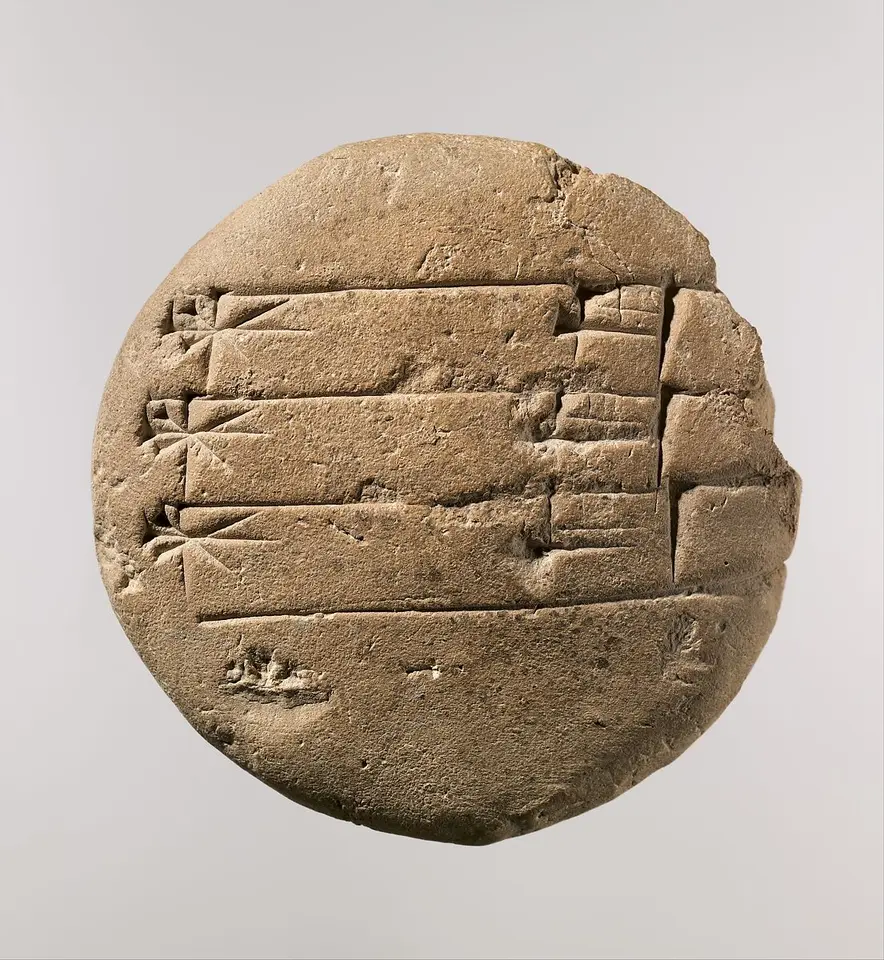
Here is a riddle from ancient Babylon:
Who becomes pregnant without conceiving, who becomes fat without eating?
Take a moment. The wording pushes you towards animals or people, which is precisely where it wants you. The answer is a raincloud.
It is a tidy little trick. A cloud swells, darkens and eventually produces rain, while doing none of the things named in the question. The imagery is strange enough to delay the answer and accurate enough to make it feel obvious afterwards. In other words, it still works.
That is the part of riddle history I find most interesting. The earliest riddles we can read are not primitive sketches of a form that only became clever later. They already know how to lead the mind down the wrong path. About four thousand years have passed, yet the basic machinery has barely needed a service.
Homework in the tablet house
The oldest riddles on record turn up among the school texts of ancient Mesopotamia. That sounds grander than the setting usually was. A Babylonian school excavated at Nippur, in present-day Iraq, occupied a modest mudbrick house in a residential neighbourhood. In around 1740 BCE, pupils gathered there to learn cuneiform. Beginners practised signs and words; advanced students tackled mathematics, religion and law. They were training to become scribes, the people who kept the administration of temples, palaces and local government moving.
The Sumerian name for a scribal school, edubba, is usually translated as “tablet house”. Very literal. Students learned by pressing wedge-shaped marks into damp clay with a reed stylus, often copying a teacher’s model. The tablets could be small enough to sit in the palm of a hand.
The tablet pictured above is one of those school exercises. It is not a riddle tablet, and there is no need to pretend otherwise. A teacher wrote the name of the deity Urash on one side; a student copied it six times on the other. It is ancient line practice, only with rather more mud.
Learning cuneiform involved hundreds of signs, and individual signs could represent different words or sounds. The work demanded memory, patience and a good feel for context. Long vocabulary lists formed a large part of the curriculum. Riddles, proverbs and short literary texts gave students something livelier to work with—and, presumably, a welcome break from copying the names of reeds, pots and legal terms.
One Sumerian riddle even describes the school itself. It asks for the identity of a house that a person enters blind and leaves seeing. The answer is the scribal school. A flattering description, certainly. Ancient teachers were not above promoting the value of education.
The school tablet is not the birthplace of the riddle; it is simply where the written trail begins. Riddles are built for speaking. They are short, memorable and assume another mind on the other side of the question. That social half of puzzling is easy to overlook when we imagine the solitary solver; a shared puzzle can give two people a third thing to attend to. By the time a scribe pressed one into clay, the riddle may already have passed through many mouths and acquired several versions. What the tablet gives us is one moment when a spoken game became schoolwork.
A familiar kind of ambush
The raincloud riddle succeeds by describing a familiar thing in the wrong vocabulary. Once clouds can become “pregnant” and “fat”, the sky briefly sounds like a farmyard. Then the answer arrives and the exaggeration makes sense.
That move is still everywhere. A child’s riddle makes an animal behave like furniture. A cryptic clue persuades you to read an ordinary word as an instruction. A lateral-thinking puzzle quietly encourages an assumption and then punishes you for making it. Different rules, same small ambush.
Cuneiform was particularly hospitable to wordplay because a sign could carry several values. That does not mean every unclear tablet hides a joke; sometimes a damaged or difficult text is just damaged or difficult. But trained readers were used to choosing between possible meanings, and a good riddler could exploit that habit.
There was also more to the game than the wording now preserved. Someone asked. Someone guessed. There may have been hints, groans, wrong answers and the irritating pause of a person enjoying their advantage. The clay records the question but not the room’s reaction. Anyone who has watched a friend refuse to reveal an answer will recognise the missing half of the scene.
A book with no answer key
Riddles next make a spectacular appearance in medieval England. The Exeter Book was written by a single scribe around 970 and contains nearly all the Old English riddles that survive—just under a hundred of them, alongside poems including The Wanderer and The Seafarer. Many speak in the first person. An animal, tool or natural phenomenon describes itself without supplying its name, and the reader has to work backwards from the clues.
The manuscript does not provide solutions. This is either admirably confident or mildly cruel. Scholars still disagree about several answers, and even the exact number of riddles depends on where you think one poem ends and the next begins.
The book itself has had a less dignified career than its present status as a literary treasure might suggest. It carries a scorch mark and a glue spill, and physical marks indicate that it was once used as a chopping board and as a press for gold leaf. In a 1327 cathedral inventory it sat among old books considered too worthless to price. Fortunately, nobody threw it away.
Old English riddlers enjoyed the same advantage as their Babylonian predecessors: ordinary objects become difficult to identify when allowed to describe themselves. We know what a tool looks like from the outside, but what would it mention about its own working life? Which details would it consider important? The shift in viewpoint is enough to make the everyday briefly unrecognisable.
Modern crossword setters work under a stricter set of conventions, but the old bargain remains. The clue may misdirect you; the answer still has to explain it. That sense of fair play is why a crossword clue can feel like a tiny promise. It is also why a weak riddle feels so annoying. If the answer only works because the writer ignored half the clues, the solver has not been beaten. The writer has cheated.
Computers changed the delivery again, not the appetite. One of the earliest word games needed only a hidden word, a row of blanks and a request for a letter. The computer that asked for a letter was doing something a Babylonian riddler would have understood immediately: withholding a name, releasing clues and waiting for the other mind to catch up.
Some scribe decided that a riddle belonged on clay. The lesson ended, the school disappeared and the question kept travelling. Four thousand years later, the raincloud is still fooling people. Not bad for homework.
Sources and further reading
- “Back to School in Babylonia”, Institute for the Study of Ancient Cultures, University of Chicago, on the Nippur school and its Sumerian school riddle.
- “Scribal Education in Ancient Babylonia”, Douglas R. Frayne, including the school riddle and an account of the scribal curriculum.
- “Riddle” in A Poet’s Glossary, Edward Hirsch, via the Academy of American Poets, for the Babylonian raincloud riddle.
- The Electronic Text Corpus of Sumerian Literature, University of Oxford, including its catalogue of proverbs, fables and riddles.
- “Aldhelm’s Enigmata and Byzantine riddles”, Anglo-Saxon England, on Babylonian school texts as the oldest recorded riddles.
- The Exeter Book, Exeter Cathedral Library & Archives.
- Old Babylonian student exercise tablet, The Metropolitan Museum of Art, object 86.11.251. The image is available through The Met’s Open Access programme under CC0.
If wordplay is where you like to linger, StillWords offers a quieter place to keep solving.
Continue in the meadow Stay a little longer in the meadow. StillWords is a calm word puzzle built around small moments of recognition, with no timers or pressure. Discover StillWords